

[ad_1]
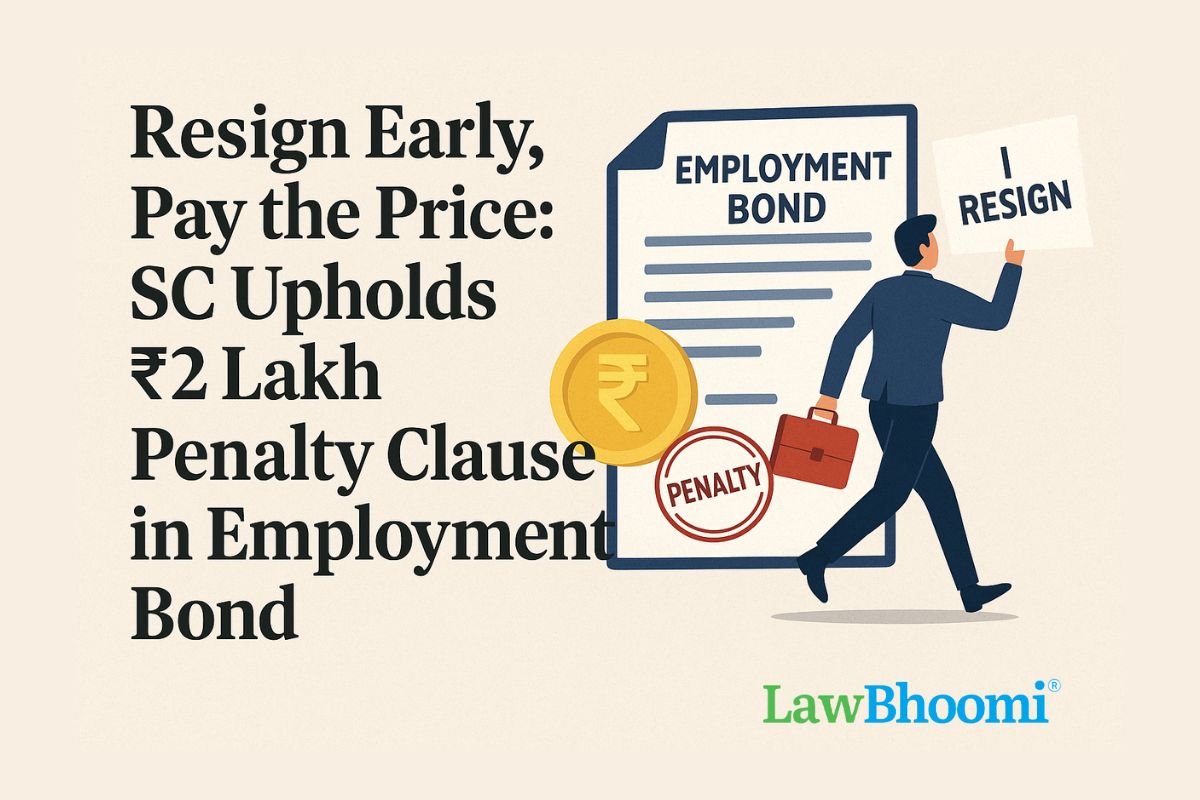
In a landmark ruling, the Supreme Court has upheld the legal enforceability of employment bonds mandating minimum service periods or financial penalties for premature resignation. The judgement clarifies that such clauses do not violate Section 27 of the Indian Contract Act, 1872, provided they are reasonable and operate only during the period of employment.
The case, heard by a bench comprising Justices PS Narasimha and Joymalya Bagchi, revolved around an employment bond clause in Vijaya Bank’s contract with a Senior Manager–Cost Accountant. The clause required the employee to serve a minimum of three years or pay ₹2 lakh as liquidated damages in case of early resignation.
The respondent had resigned prematurely to join another bank and challenged the bond’s validity, arguing that the penalty clause was oppressive, contrary to public policy, and effectively barred him from alternate employment. He claimed that the ₹2 lakh penalty violated his rights under Section 27, which prohibits restraint of trade.
However, the Court rejected these arguments, ruling that public sector undertakings (PSUs) like Vijaya Bank have a legitimate interest in retaining skilled employees and minimising recruitment costs. The bench emphasised that reasonable restrictions during employment are valid, as long as they do not extend beyond the contract’s duration.
“The appellant-bank is a public sector undertaking and cannot resort to private or ad-hoc appointments through private contracts. An untimely resignation would require the Bank to undertake a prolix and expensive recruitment process involving open advertisement, fair competitive procedure lest the appointment falls foul of the constitutional mandate under Articles 14 and 16,” the Court observed.
The Court further held that the ₹2 lakh penalty was not excessive for someone serving in a lucrative managerial post.
“Judged from that perspective, the quantum of liquidated damages was not so high as to render the possibility of resignation illusory,” the judgement noted.
While supporting the legitimacy of such restrictive clauses during the tenure of employment, the Court cautioned against oppressive or unconscionable terms, especially in standard-form contracts where employees may lack bargaining power. The bench referred to earlier rulings including Niranjan Shankar Golikari v. Century Spinning Co. (1967) and Superintendence Co. v. Krishan Murgai (1981) to reiterate that restrictive covenants are permissible only during the subsistence of employment, not after termination.
The judgement recognised evolving principles of public policy in a deregulated market economy. It underscored that retention of skilled workforce, efficiency, and administrative stability are legitimate objectives for public sector employers.
“This prompted the appellant-bank to incorporate a minimum service tenure for employees, to reduce attrition and improve efficiency. Viewed from this perspective, the restrictive covenant prescribing a minimum term cannot be said to be unconscionable, unfair or unreasonable and thereby in contravention of public policy,” the Court added.
The ruling is expected to have significant implications for employment practices in both public and private sectors, especially in domains requiring high investment in training and retention of specialised skills.

Attention all law students!
Are you tired of missing out on internship, job opportunities and law notes?
Well, fear no more! With 1+ lakhs students already on board, you don’t want to be left behind. Be a part of the biggest legal community around!
Join our WhatsApp Groups (Click Here) and Telegram Channel (Click Here) and get instant notifications.
[ad_2]
Source link