

[ad_1]
In a significant move to boost formal employment, the Government of India has approved the Employment Linked Incentive (ELI) Scheme — a landmark initiative aimed at encouraging employers to create more jobs and formalize the workforce. This scheme is expected to play a critical role in aligning the growth of industries with employment generation.

🔍 What is the ELI Scheme?
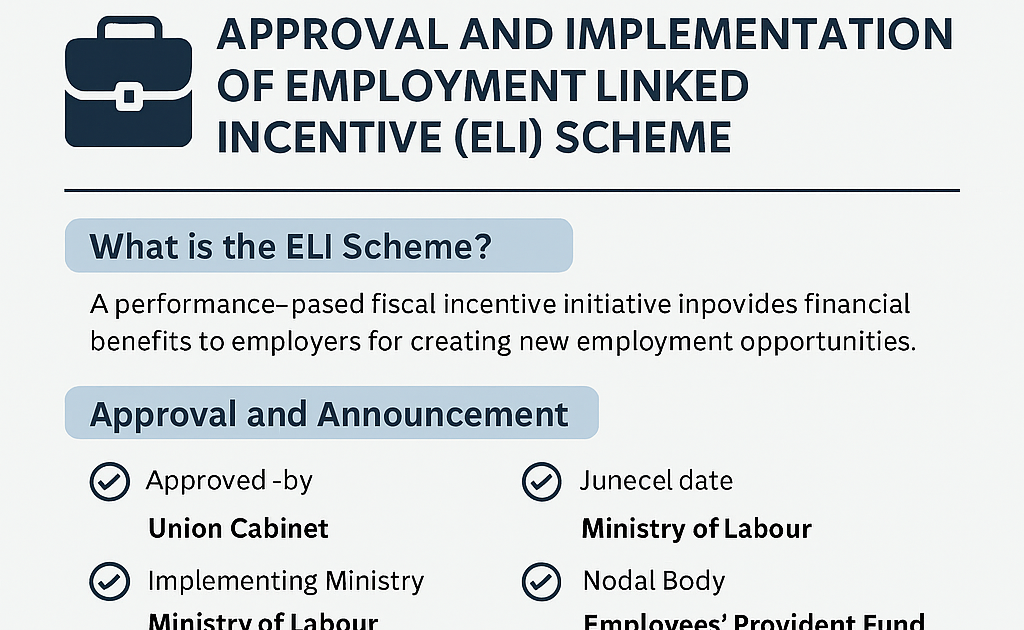
The Employment Linked Incentive (ELI) is a performance-based fiscal incentive scheme where employers will receive financial benefits for creating new employment opportunities. The scheme is designed to reduce the cost of employment for enterprises and simultaneously enhance social security coverage.
🏛️ Approval and Announcement
✅ Approved by: Union Cabinet, Government of India
✅ Date of Approval: June 2025 (official Gazette notification expected shortly)
✅ Implementing Ministry: Ministry of Labour & Employment
✅ Nodal Body: Employees’ Provident Fund Organisation (EPFO)
🎯 Objectives of the Scheme
-
Promote employment generation in the formal sector.
-
Encourage registration of workers under social security platforms like EPFO and ESIC.
-
Support MSMEs and startups in absorbing new workforce.
-
Bridge regional employment gaps by focusing on semi-urban and rural job markets.
💰 Key Features of the ELI Scheme
| Feature | Details |
|---|---|
| Incentive Type | Direct fiscal subsidy to employers |
| Target Group | New employees drawing wages below ₹25,000/month |
| Coverage Period | Up to 3 years for each new eligible employee |
| Eligibility | Establishments registered under EPFO & compliant |
| Incentive Amount | Govt. pays employer’s share of EPF contribution (12%) |
| Employment Threshold | Minimum 10 net new jobs/month for eligibility |
📈 Implementation Framework
-
Digital Interface: Integrated with EPFO’s unified portal to track job creation in real-time.
-
Verification Mechanism: Monthly ECR (Electronic Challan Return) filings will be cross-verified.
-
Disbursement: Direct Benefit Transfer (DBT) into employer’s linked account upon validation.
-
Audit: Annual third-party audit to prevent misuse and ensure accountability.
🏭 Who Can Benefit?
-
Micro, Small & Medium Enterprises (MSMEs)
-
Startups hiring fresh graduates
-
Manufacturing and services sectors expanding workforce
-
Gig economy platforms formalizing contractual workers
⚖️ Legal & Regulatory Support
🌍 Broader Impact
-
Social Security Inclusion: Increased EPFO/ESIC coverage among youth and informal workers.
-
Boost to Formal Economy: Encourages payroll transparency and reduces wage fraud.
-
Regional Upliftment: Companies in tier-2 and tier-3 cities get higher incentives.
-
Gender & Diversity Boost: Additional incentives may be introduced for hiring women and PwDs.
📌 Key Differences from Previous Schemes
| Parameter | ELI Scheme (2025) | Atmanirbhar Rozgar Yojana (2020) |
|---|---|---|
| Duration | Up to 3 years | 2 years |
| Monthly Salary Cap | ₹25,000 | ₹15,000 |
| Implementation Tech | Real-time EPFO tracking | Basic ECR monitoring |
| Focus Areas | MSMEs, gig workers, rural jobs | General formalization post-COVID |
📣 Final Thoughts
The Employment Linked Incentive Scheme marks a proactive step by the Government to tie economic growth with real, measurable employment. It is more than just a financial incentive — it’s a structural shift aimed at ensuring that India’s economic recovery translates into mass job creation and formal workforce integration.
For employers, this is the ideal time to expand and align with the government’s goal of a formal, secure, and inclusive labour market.
📢 Stay Updated
For official notifications and ELI registration guidelines, visit:
🔗 https://epfindia.gov.in
🔔 Subscribe to our YouTube Channel: Compliance Monk for all labour law updates!
[ad_2]
Source link