

[ad_1]
Paulo Ilich Bacca*

Source: Courtesy of Edwin Ceballos – Archive of the University of the Pastos and Quillasingas Peoples.
A travel chronicle through the mountains of Nariño, a department located in southwest Colombia that borders Ecuador, documenting the creation of a university that offers a new perspective on earth jurisprudence in the Global South.
The central park of Cumbal, in the department of Nariño, is covered with the dark felt hats of the Pastos community members, which, in turn, contrast with the hats woven from caña brava worn by the delegation of Misak women attending the First Constitutive Congress for the creation of the University of the Pastos and Quillasingas Peoples. The Cumbal volcano, standing before the town’s main church, evokes the connection between Andean spirituality and European Catholicism.
As we wait for the camper trucks that will take us to the Indigenous Educational Institution Cumbe, the Cumbal volcano—central to understanding territorial laws—reminds us that European rationality never fully triumphed in this land, which managed to integrate its ritual economy even amidst colonial exploitation. In many ways, the cosmological beings inhabiting the volcano became intertwined with Catholic imaginaries, reflecting a projection of Christian imposition in form, while simultaneously reinterpreting the biocultural knowledge nurtured in the living university of this region, where, as poet Aurelio Arturo once evoked, green transforms into all colors.
In these intricate mountains, the clamor of the Pastos and Quillasingas to establish their own university—rooted in their struggles for land and the consolidation of their fundamental rights—sparked dialogues around their territorial educational processes. The genesis of this endeavor is interwoven with decades of political, social, and cultural mobilization. As Taita Ramiro Estacio recounts, generously sharing the collective memory recorded in this chronicle, from the 1970s to the 1990s, Indigenous communities mobilized in pursuit of historical reparations. They reclaimed the lands that had been taken from them and demanded full recognition of their right to self-determination. It was in this way that the dream of a university embodying their life plans began to take shape.
The struggle became a call for resistance and liberation, an unyielding quest to clarify their thinking and strengthen their governance, economy, and justice systems. As the women of Cumbal recall, it was time to ‘recover the land to recover everything’. This maxim, deeply rooted in Pastos Peoples’ cosmology, reinforced the idea of an institutional dialogue between state jurisdiction and Indigenous jurisdiction as equals—echoing the exchanges promoted between Indigenous and non-Indigenous peoples within the university.
At the time, the vision of a University of Life, one capable of enriching Western perspectives through Indigenous knowledge, sparked intense academic debates and polarized opinions in the media of Nariño. This process continued to organically intertwine pedagogy and social mobilization, reaching a pivotal moment in 1991 with the participation of the Indigenous movement in the National Constituent Assembly.
The University from earth jurisprudence

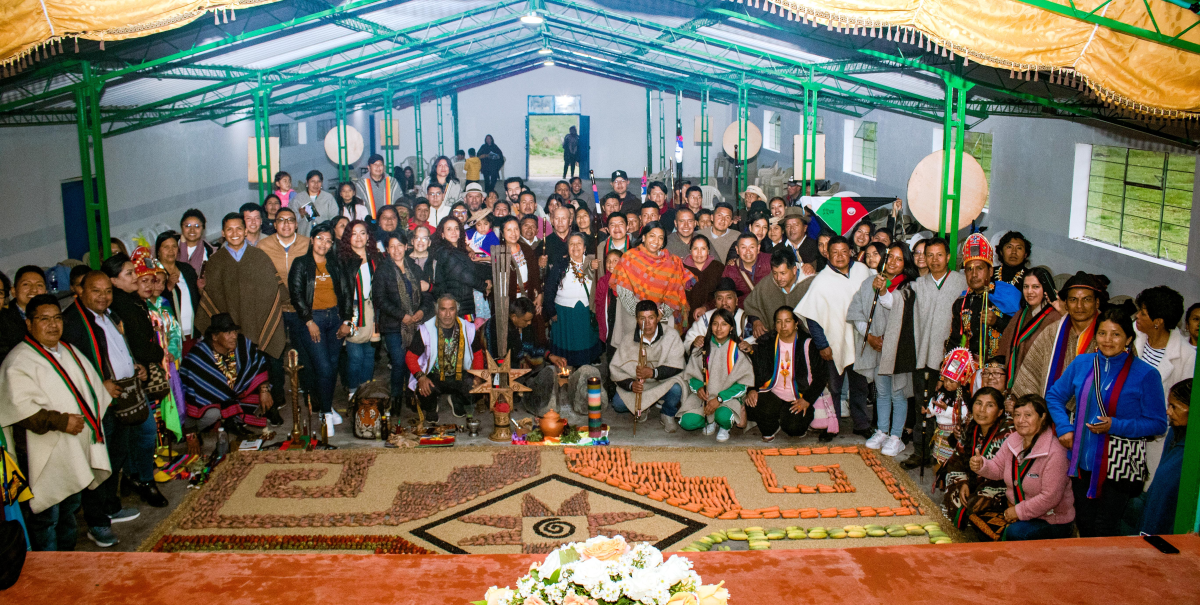
(Community members and participants in the Constituent Congress of the University of the Pastos and Quillasingas Peoples.)
Woven into the recesses of history, the struggle for an autonomous university in the territories of the Pastos and Quillasingas transcends past, present, and future. Just as the Andean University of Felipe Guamán Poma de Ayala (1535–1616) had the versatility to reflect on the pre-Hispanic past from within a colonial present and propose a future grounded in its own legal traditions, the agenda of the Indigenous University has engaged in a fluid dialogue with constitutional and international law. On one hand, it seeks to enrich these legal frameworks with life-centered perspectives that transcend anthropocentrism; on the other, it aims to translate human rights principles through the biocultural complexity in which Indigenous peoples develop their ways of life.
The Indigenous University has been the dream and relentless struggle of great leaders in the territory, among them Taita Ramiro Estacio, who has led the mandate of the Indigenous Authorities of the Pastos and Quillasingas in making this vision a reality. This is not merely a university that seeks to strengthen the knowledge and wisdom of its peoples, but one that forges a path where research and social transformation become messages of life across time.
As the journey toward the Indigenous University unfolded, Taita Ramiro expressed his collective sentiment, making it clear that his words belong to and serve the community. In keeping with the teachings of the elders, he entrusted the representation of this endeavor to the Commission on Education of the Pastos and Quillasingas, the Laureano Inampues School of Law, the Association of Indigenous Pastos Teachers, the Higher Council on Pastos Education, and, more broadly, the Regional Table of the Pastos and Quillasingas. Together, these bodies engage in dialogue with the National Government to realize the university’s creation as a fulfillment of this communal, territorial, cultural, spiritual, and organizational mandate.
Law has been a crucial area of knowledge in the effort to decolonize curricula from within the territory. At the University of the Pastos and Quillasingas Peoples, rigorous study of non-Indigenous legal systems is undertaken because they contain fundamental elements necessary to uphold Indigenous law. To consolidate the exercise of Ancestral Authority, it is essential to ensure that the legality of ancestral territories is not called into question.
According to the speakers at the First Constitutive Congress of the University, this dialogue is indispensable in the construction of an institution that engages with other cultures. Such is the vision of a university inspired by the thought of leaders like Juan Chiles and Manuel Quintín Lame, jurists from the Pastos and Nasa peoples, respectively.
Juan Chiles and Quintín Lame—whose voices have echoed throughout the various phases of the university’s formation—moved adeptly between the Indigenous and non-Indigenous worlds. Both were able to interpret their peoples’ cosmologies while reexamining the colonial and republican laws designed to dismantle ancestral territories. Though Juan Chiles lived around the 1700s, his thinking was crucial in reading Law 89 of 1890—openly racist and ethnocentric—through the lens of his cosmological foundations. As the elders say, one must ‘know how to unravel the Quichua letters’ but also ‘know how to read the writings of Charlemagne.’
In this way, the Pastos people reinterpreted this law, bridging the colonial past with the republican present. They did so by drawing upon their own sources of law and ensuring the continued recognition of their colonial-era resguardos (Indigenous landholdings), demarcating them through cosmo-referential spaces such as volcanoes and lagoons.
This adaptive interpretation of colonial law—both a critique of colonialism and a reclamation of Western legal frameworks—is intrinsic to the university envisioned by Chiles and Lame. Thus, the University of the Pastos and Quillasingas Peoples has been forged through intercultural dialogue and an invitation to explore alternative epistemologies.
Some of these dialogues, brought to life in Cumbal by Lucía Tunubala and Santos Jamioy in their lectures Stoking the Fire of Ala Kusreik Ya-Misak University and Pedagogies of Mother Earth, have been unfolding for centuries. Among their many creative juxtapositions is the fusion of lunar and solar calendars with European agricultural practices, a testament to the university’s deep commitment to intercultural knowledge.
The Word of the Peoples as the Foundation of the University

((From left to right) William Guadir; Fernando Guerrero, program coordinator; Aurora Vergara, Minister of Education; Ernesto Estacio, general coordinator; Gilberto Tapie and Eliana Mendieta, from the Ministry of Education.)
As the afternoon fades and the voices of the community echo through the mingas, workshops, and assemblies that have shaped the creation of the university, Taita Ramiro Estacio speaks with conviction about the challenges and demands of this educational project:
This university is the main stage for strengthening the life systems of our peoples and fostering conditions of equality, justice, and epistemic mediation. Education, research, and social engagement are rooted in these life systems, and it is precisely these systems that give rise to a university designed for social transformation in the territories.
The cries of birds crossing the horizon weave together with the vibrant colors of woven fabrics and the voices of community members envisioning a university for life. The voices of Indigenous educators such as Jorge Chiran and Lucía Moreno call for conceiving this university from a collective perspective. In their vision, the university is the territory itself, born from the living memories of community mingas (an indigenous tradition of cooperative work for the common good).
Taita Jesús Omero Cuasialpud joins this reflection, expressing his hope that the university will become a seedbed for leaders who will shape a plurinational country rooted in the autonomy that sustains Indigenous peoples and nationalities. Adding to these perspectives is Fernando Guerrero, who leads the development of the university’s programs and research. A philosopher and literary scholar from Túquerres (Nariño), he envisions the university as a space to strengthen Indigenous knowledge within the living cosmos of their territories:
The creation of this university settles a historical debt owed to those who dare to rethink education. It is necessary to change the way research is conceived—it should be designed to address major global crises, the future of our generations, social transformations, and the exploration of the deep wisdom embedded in our life systems.
As the day comes to a close, Taita Gilberto Tapie reflects on how the creation of the university has posed challenges both internally and externally. Internally, it has required balancing discourse and collective leadership. Externally, it has confronted perceptions that the Pastos were an obstacle to progress. In both cases, traditional knowledge systems remain essential in addressing the environmental and humanitarian crises of our time.
All these voices converge in the direction set by the land and its communities. Those leading this effort continue to face the academic, technical, and political challenges that arise daily. This is a story of struggle rather than a celebration free of self-criticism—an examination that will also be necessary. For now, the goal of its founders is for the University of the Pastos and Quillasingas Peoples to open its doors to students in the coming months.
* Deputy Director of the Center for the Study of Law, Justice and Society (Dejusticia) based in Bogota, Colombia. Paulo studies Indigenous cosmologies of the Andes and the Amazon to promote environmental justice. He has written academic books, school textbooks, intercultural guides, and journalistic chronicles using field diaries. He is currently completing Indigenizing International Law, an ethnography on the climate crisis and justice beyond the human.
[ad_2]
Source link